(Image credit: Getty Images, 2024)
(Image credit: Getty Images, 2024)
It’s 16:19 on Wednesday at Augusta National Golf Club on Masters Week, the stage is set on the 9th, a 107-yard hole with a treacherous water hazard and slight breeze coming back into the players’ faces. The golfer’s driver comes down on the ball like a pendulum, clean contact is made, the ball soars through the sky, hits its apex, but alas, doesn’t quite make it and finds the drink. He receives a flurry of high-fives and is met by a packed crowd, encouraging him to go again. For 8-year-old Frankie Fleetwood, an Augusta regular at this point, he doesn’t need to be asked twice, with a beaming smile on his face, he tee’s up his ball again, ready to rip another (unfortunately, once more into the water).
The Masters, from a literal standpoint, is one of sports most inaccessible, elite and exclusive events in the sporting calendar, steeped in years of rigid yet quirky traditions and history. It sees 50 of golf’s greatest going head-to-head for three gruelling days for the chance to win golf’s greatest prize…a green jacket, and a handsome purse in excess of $4 million. That said, just 24 hours before battle commences, an incredibly unique tradition takes place that puts competitiveness aside and focuses purely on family.
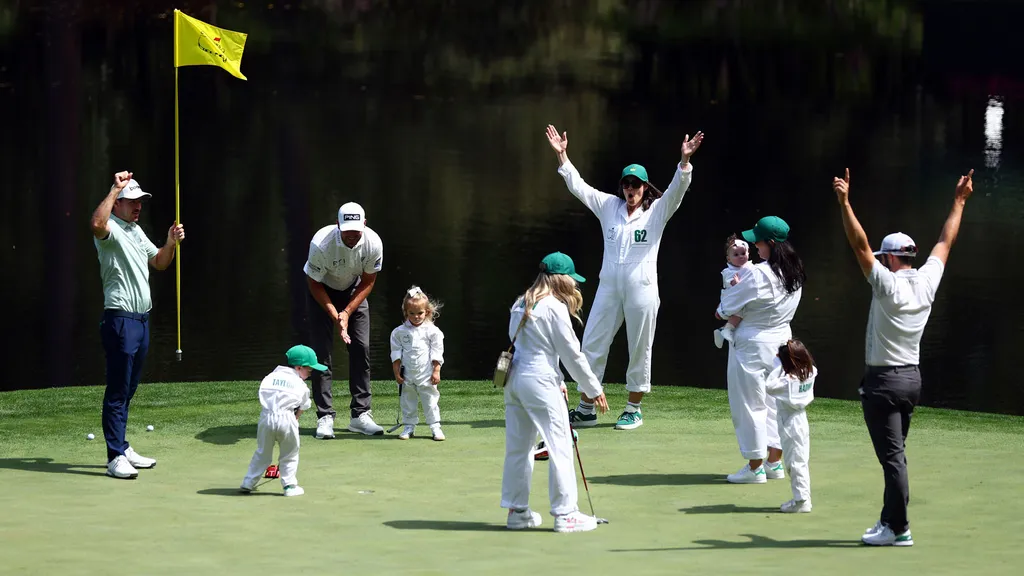
Each year, on the Wednesday before everything officially kicks off, all playing golfers are invited to take part in the Par 3 contest. The fun part, their family joins them, pottering around acting as a caddie and hitting the ball when they feel fit, which makes for a light-hearted bonding moment for players and spectators alike. It’s worth noting, that this is all done on a course that is usually accessible to only around 300 people in the world.
The tradition began over 60 years ago and works so well because everything you see feels, and is, genuine and authentic. From a business perspective, the ability to generate emotional engagement in the face of a seemingly stuffy and disconnected sport is incredibly impressive and hugely benefits the sport and competition.
Firstly, from a fandom level, the carefree, silly, yet wholesome content is a perfect starting point for anyone. If I’m ever trying to get the Masters on the TV against popular opinion, the first port of call will be showing Par 3 contest social media content. Anything from players skilfully skimming the ball across the water onto the green, to cute children taking their first interview, to Tony Finau’s infamous hole-in-one, and what followed – these all have instant impact.
The instant impact, as we know at We Are Family, is an integral part of The Children and Teens’ fandom journey. The wow factor that this day brings is the perfect opportunity, prior to three days of what might be deemed a bit of a yawn fest in isolation, to get younger fans interested and perhaps enough for them to one day graduate onto watching the serious stuff on the Thursday (speaking from experience). Equally, the reason the day brings as many eyes as it does is because it’s entirely accessible for the younger fans. It’s a foot into the proverbial golfing door where barriers are removed - the rulebook torn up, terminology and the scoreboard are irrelevant and family and fun are the purpose, once more breaking pre-conceived ideas about golf.
As to why it seems so accessible, this is due to the authenticity of the day and interactions within. It’s not just a token gesture that players have to partake in to be eligible for prize money, it’s an opportunity on the eve of the most important golfing week of the year, and for some, their career to take a step back and spend time with their family. The ones that so often put up with their absurd travel, training programmes and performance-dependent mood swings. At its core, the bonding and emotions we see are relatable, irrespective of who these people are and the talent they hold, which The Masters and associated platforms package up so well. It’s evident that it has nurtured a certain audience in the advertising shown, largely family, specifically child-centric. A stark difference to its somewhat archaic counterpart, cricket, littered with life insurance, hair loss treatment and cruise holidays ads.
So often at We Are Family, we have clients ask how they can better engage younger fans and whilst there isn’t a one-size-fits-all, I think The Masters’ accessibility dichotomy is proof that anyone can do it. At the heart of it, opening with a fun, and thus impactful event that oozes authenticity (even if in the back room they have commercialised it over the years) is ingenious. Whilst this has worked so well for The Masters it’s about catering it to your purpose and tone of voice. Being able to understand what your brand looks like, the data behind it and any opportunities is vital for this, because unlike golf, it isn’t a matter of sticking your finger in the air and hoping.
Watch now - Frankie Fleetwood at the Masters